
Long Residence (10-Year)
Must have 10 years of continuous lawful residence.
NEW: If your current visa was granted after 11 April 2024, you must have held it for at least 12 months before applying.
The rest of the key points ↓↑
- Absences after 11 April 2024 must not exceed 180 days in any 12-month period.
- Absences starting before 11 April 2024 are subject to the old 548-day total limit.
- Must meet the English language and Life in the UK requirements.
What the 10-year long residence route is
Most routes to settlement ask you to spend a fixed period on one kind of permission — five years as a Skilled Worker, five years as a partner. The long residence route asks something different: that you have lived in the UK lawfully and continuously for ten years, whatever permission you held along the way.
That makes it the route for people whose immigration history does not fit a single box. A decade that began as a student, became a Graduate, then a Skilled Worker, then a partner, counts as one continuous period — provided every part of it was lawful and the continuity was never broken.
It is also the route with the most ways to go wrong, because ten years is long enough for gaps, long trips and forgotten refusals to accumulate.
Who this route is for
You may be on this route if:
- You have been in the UK for around ten years or more
- You held permission for that whole period, or nearly all of it
- Your permission changed type one or more times
- No other settlement route gets you there sooner
If you have spent five years on a single work or partner route, that route will almost always be faster — see Skilled Worker or the partner route. Long residence is the route you use when the shorter ones do not apply.
The continuous residence requirement
Continuity is the part people underestimate. It is not simply "did I have a visa" — it is whether the ten years hold together as one unbroken period under Appendix Continuous Residence.
Two things break it, and they behave very differently:
Time spent outside the UK. There is a limit on how much of the ten years you may spend abroad, and it is applied across any rolling twelve-month period, not per calendar year. A run of long trips that looks reasonable year by year can still breach it.
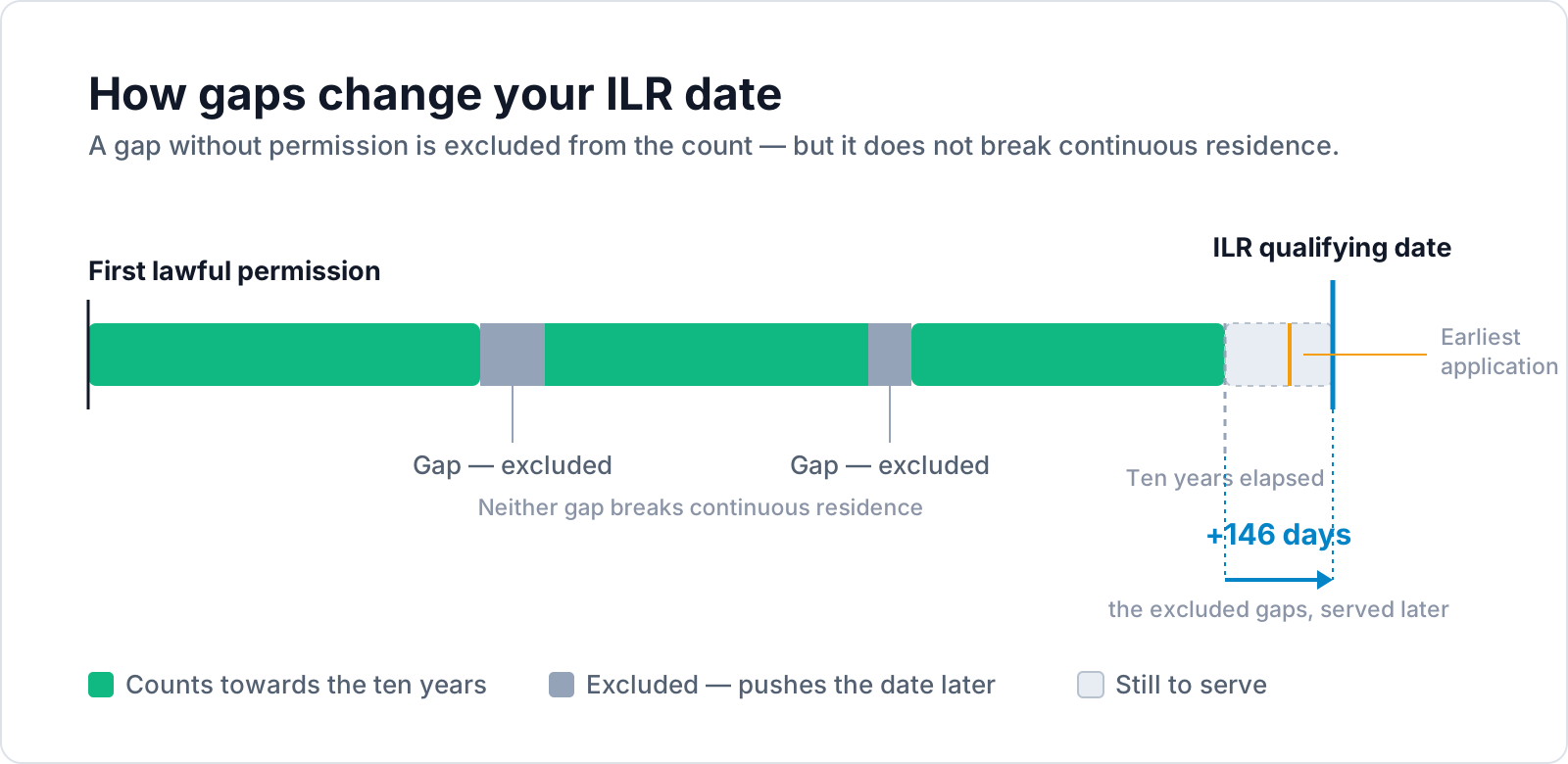
Time without permission. A gap between one visa expiring and the next being granted is not counted towards your ten years. Importantly, this does not always break your residence — some gaps are excluded from the count while leaving the continuity intact. The practical effect is that your qualifying date moves later by the length of the gap.
That distinction — excluded but not broken — is the single most misunderstood mechanic on this route, and it is what the Long Residence calculator works out for you.
Which visas count towards the ten years
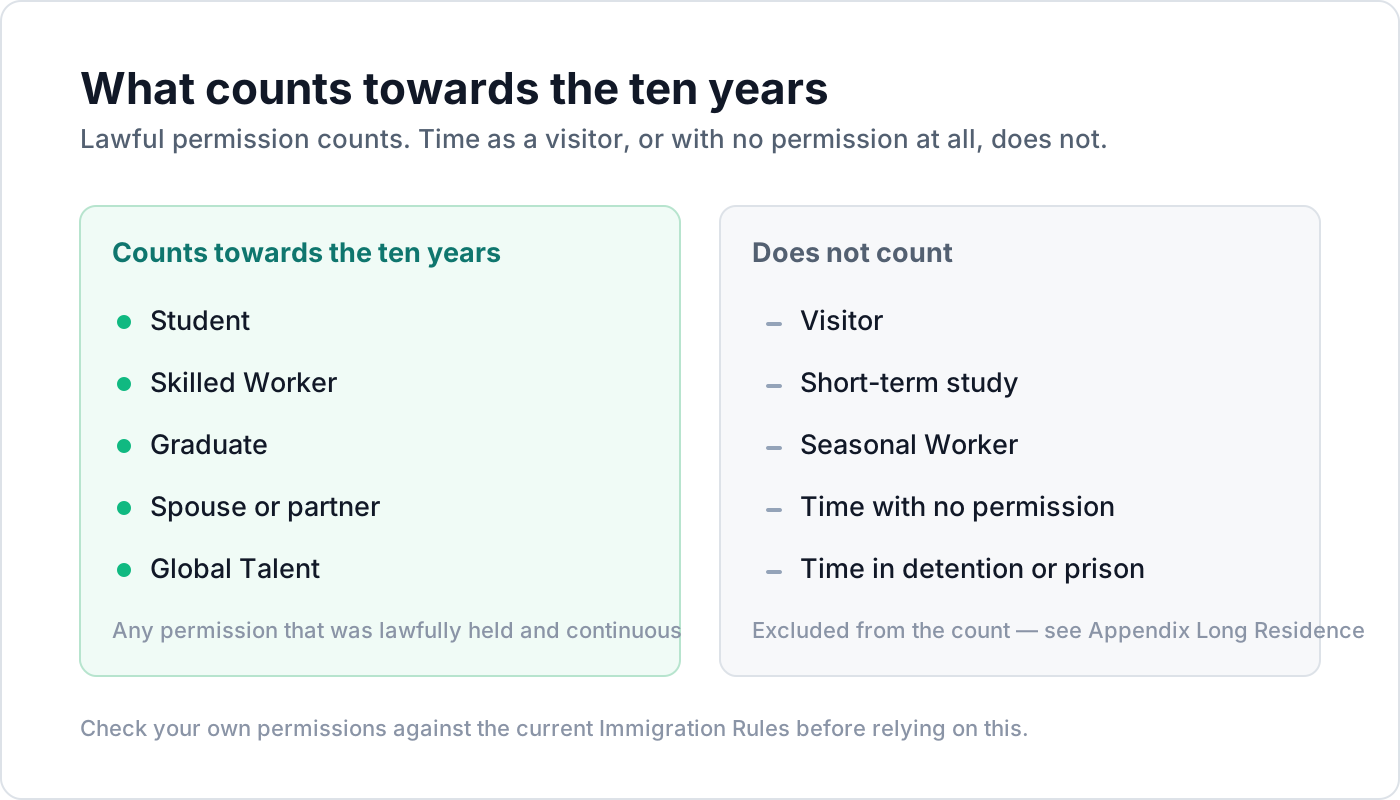
Broadly, time on any permission that was lawfully held counts. Time as a visitor does not, and neither does time with no permission at all.
Because the excluded categories change, check your own permission history against the current Immigration Rules rather than relying on a summary — including this one.
Gaps in permission
A gap does not automatically end your claim. The Rules recognise several situations where a period without permission is disregarded for continuity purposes, including where an application was made in time and the previous permission was extended by law while it was decided.
What a gap almost always does is push your qualifying date later, because the days without permission do not count towards the ten years. If you had two gaps totalling 146 days, your ten years is reached 146 days later than the anniversary of your arrival.
The other requirements
Ten years of residence is necessary but not sufficient. You will also need to meet the requirements that apply to settlement generally:
- Knowledge of Life in the UK — normally by passing the Life in the UK test
- English language — at the level required for settlement, unless you are exempt
- Suitability — including your immigration and criminal history
When you can apply
You do not have to wait until the very day your ten years is complete. The Rules allow an application a short period in advance, and the Long Residence calculator applies the current allowance to your own dates.
Applying before you are eligible is a refusal and a lost fee. Applying late risks a gap in your permission. Working out the exact date is the whole reason this tool exists.
Is this route changing?
The Government has consulted on replacing the current settlement framework with an "Earned Settlement" system, under which the separate long residence route would be removed. As of the date shown on this page that reform is proposed and not law — no Immigration Rules have been laid, and the existing route continues to operate.
Because this affects anyone counting towards ten years, we track it separately and update it when the position changes.
Before you rely on this
VisaXplain is not a law firm and does not give immigration advice. This page explains published rules and the calculator applies them to the dates you enter. It cannot know facts you have not told it, and it cannot tell you what to do about your own case. Check the official GOV.UK guidance, and take advice from a regulated adviser before you act.
Eligibility Checker
This is guidance, not legal advice. VisaExplain is not a law firm and is not regulated to give immigration advice. This tool applies published Immigration Rules to the answers you give and shows you the rule behind each result. It is general information — it is not a decision on your case, and it is not a substitute for advice from a qualified adviser.
Rules change, and your circumstances may include facts this tool does not ask about. Always check the official GOV.UK guidance, and take advice before you act. VisaExplain accepts no liability for any loss arising from reliance on this tool.
This site is published in English only. Find a regulated adviser · Disclaimer
UK, USA, Canada, Australia, New Zealand, Ireland, and others
Must be confirmed via UK ENIC (formerly NARIC)
Required for ILR applications. Cost: £50
Including spent and unspent convictions
5 questions still to answer
- Are you from a majority English-speaking country?
- Do you have a UK-recognised degree taught in English?
- What is your proven English level (SELT)?
- Have you passed the Life in the UK Test?
- Do you have any criminal convictions?
Continuous Residence & Absence Tracker
Calculate your exact ILR eligibility date against the 180-day absence rules.
Long Residence (10-Year) Updates & Policy Breakdown
No published updates for this category yet.
Frequently Asked Questions
Continuous residence means time spent in the UK without significant breaks. You are generally allowed to be outside the UK for up to 180 days in any 12-month period. For absences before April 11, 2024, total absences should not exceed 548 days, and no single absence should be longer than 184 days.
You can submit your application as soon as you meet all the eligibility requirements (usually 28 days before the 10-year anniversary of your first arrival on a qualifying visa). You must be in the UK to apply.
Time spent in the UK on a Standard Visitor visa, as a visitor without a visa, on a Short-term study visa, on a Seasonal Worker visa, or under any of the Ukraine schemes does not count towards the 10-year continuous residence period.